
Town of Hamburg City Directory Collections by Era
The Buffalo & Erie County Public Library holdings guide is the starting catalog for a Town of Hamburg city directory search. Its town-of-Hamburg run is cataloged under F129 .H273P6 for 1962 through 1974, then 1976, 1977, 1979, and 1980. Those are shelf years, not proof that every intervening volume was issued or survives. The guide also points to regional suburban books that can continue a name or address trail when the town-specific run stops.
| Collection | Years | Where Held | Access |
|---|---|---|---|
| Hamburg, town of directory, F129 .H273P6 | 1962–1974, 1976, 1977, 1979, 1980 | Buffalo & Erie County Public Library | Request the call number and exact year; verify the title page. |
| Buffalo Southeast Suburban directory | 1963–1966, 1968–1979 | Buffalo & Erie County Public Library | Regional volume; ask for the Hamburg section and any reverse section. |
| Buffalo South Towns and Southtowns directories | 1983–1990, 1992–1994; Hamburg listing from 1983 to present | Buffalo & Erie County Public Library | Check the individual volume because the catalog describes a regional run. |
| Buffalo South Suburban directory | 1992, 1993, 2003, 2004–present | Buffalo & Erie County Public Library | Later regional successor for much of the earlier suburban coverage. |
| Erie County histories and directories | 1884, 1906, and 1914–1919 material | NYG&B digital collection and Grosvenor Room | Search or browse online, then treat biographies as context rather than a full address list. |
Directory titles can sound narrower than their actual reach. A Buffalo suburban volume may include Town of Hamburg entries, while a town name can appear under a different regional title. Ask the librarian for the requested year, the place heading, and whether an address-order section is present before treating a failed name search as final.
Town of Hamburg City Directory Runs Change Names
The collection has a useful sequence, but it is not a single publisher's uninterrupted series. The Hamburg-town shelf begins with the 1962 volume presently listed in the guide. Southeast Suburban books overlap the 1960s and 1970s. South Towns books carry listed coverage from 1983 into the 1990s, and South Suburban volumes appear for 1992, 1993, 2003, and from 2004 onward. The catalog does not establish that every book used the same format, so title, publisher, and abbreviation key should be checked in each volume.
A practical timeline is therefore: begin with the town run for 1962–1980, check Southeast Suburban during its listed years, then move to South Towns or South Suburban for later coverage. The apparent breaks are meaningful. They may reflect a missing shelf year, a regional title change, or a volume that does not include the needed address. Record what was searched and what the catalog actually lists.
How a Town of Hamburg City Directory Entry Reads
No official web source reviewed provides a scanned 1962–1980 Town of Hamburg entry. The following is an expected inspection inventory, not a confirmed transcription of a Hamburg volume. Once a volume is in hand, photograph or note its title page and abbreviation key first. Then compare every mark in the entry with that book's own explanations. A similar-looking symbol can mean something different in another publisher's directory.
| Alphabetic name | Expected head-of-household listing; confirm initials, spelling, and any spouse line against the scanned page. |
|---|---|
| Address | Expected street number and street name; verify the street spelling and whether it is a residence or business listing. |
| Occupation line | Expected in many directories, sometimes with a business name; it is a clue for separating same-name people, not proof by itself. |
| Ownership or residency notation | An owner mark or other notation may occur, but its form and meaning must be confirmed from that volume's key. |
| Telephone, widow, or business notation | These are expected conventions in some editions only; confirm them from the actual book before relying on them. |
- Criss-cross directory
- An address-order or street-order section that can lead from a house number to the listed household or business for that year.
- Householder index
- An alphabetic arrangement of people or households, often used to move from a surname to a street address.
- Abbreviation key
- The publisher's explanation of shortened labels and symbols. It is the only sound way to interpret a mark in that volume.
Town of Hamburg Digitized Directory Books Need Care
The Erie County Histories and Directories digital collection makes the 1884 H. Perry Smith history and the 1906 Genealogy Publishing Company Memorial and Family History available for searching and browsing. Both can place a person in a Town of Hamburg historical setting. The 1906 material includes a Hamburg town section and biographical sketches. Neither book is a complete roll of residents or a substitute for a later street-and-name directory.
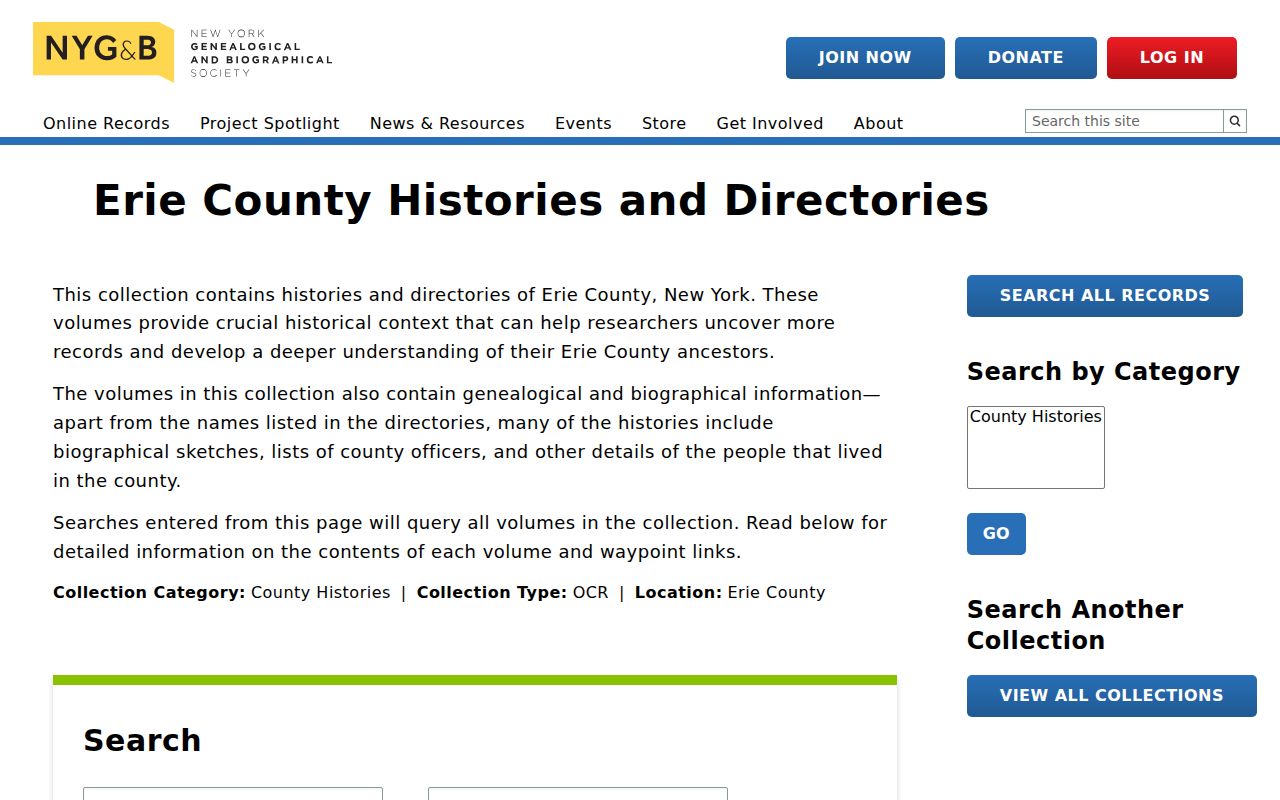
The digitized Erie County collection shows the online historical-books route used alongside shelf directories.
A biography can supply a place, family relationship, civic role, or date worth checking against a census, deed, church record, or newspaper. It cannot establish that everyone at an address appears in the book. Treat the digitized volumes as a strong context layer and keep the volume title and page with every note.
Myth check. A searchable historical book can be useful without being a complete city directory, so a missing name is not proof that a Hamburg family was absent.
Town of Hamburg Library Access to Directories
Hamburg Township Library's genealogy gateway is a local fallback for census images, historical books, church material, and other family-history research. It is a FamilySearch affiliate, which can expose some digitized images that are restricted when viewed remotely. Call before a visit to confirm the access route for a particular image or catalog item. The public genealogy page is a gateway, not an online directory search screen.
The Hamburg Historical Society/Museum reopening notice describes the collection's researcher access for the Town and the villages of Hamburg and Blasdell. Its public site does not publish a complete shelf catalog or a fee schedule. The 2026 notice sets public hours at noon to 3 p.m. on Saturdays and the first Sunday of each month after 11 April. Ask about photographs, local census copies, cemetery material, clipping files, unpublished papers, and house-history material.
Insider tip. An affiliate-library visit can open image access that a remote search does not, so an online dead end is a reason to check the local catalog, not to stop.
Trace Town of Hamburg City Directories by Year
Use the name-and-address volumes as dated snapshots. Start in a listed 1960s through 1980s Hamburg volume with a surname and given name, then capture the spelling, street address, spouse notation, and any abbreviation that the key confirms. An old address can be approached from a reverse section first, if that edition has one, and then from the alphabetic listing. For the modern address-keyed record path, use the Town of Hamburg by-street directory rather than trying to turn an old directory into a current record.
- Find the earliest listed volume that contains the person or street, and write down the exact source title and year.
- Check the adjacent available volume, preserving every spelling, address, and confirmed abbreviation instead of normalizing it.
- When the town run has a gap, look in the Southeast Suburban, South Towns, or South Suburban title for the matching period.
- Pair the directory year with the appropriate federal census decade. The 1950 schedule is the newest federal census public under the 72-year rule at the research date.
- For earlier families, pair 1855, 1865, and 1875 New York census material with nearby federal schedules and local microfilm routes.
A disappearance has several possible explanations: a move, a death, a different spelling, an omitted edition, or a regional-title shift. It does not settle the question alone. Search the next available directory, an obituary, a cemetery lead, or a newspaper notice before deciding that the trail has ended.
Town of Hamburg Directory Gaps Meet Local Newspapers
Local titles can bridge years that directories miss. The New York State Library inventory identifies fragments of the Hamburg Sentinel, Hamburg Sun, Hamburg Sun and Erie County Independent, and The Sun and Erie County Independent at combinations of the Hamburg Public Library, Historical Society, Town Historian, Buffalo & Erie County Historical Society, and other repositories. Obituaries can establish a death and surviving family. Social columns can connect households. Legal notices and property advertisements can supply an address or estate lead.
Record the newspaper title, issue date, page, and holding repository each time. Search both a surname and the geographic form likely to have been printed, including Hamburg, Blasdell, Lake View, Wanakah, or a postal-city label. A newspaper notice is evidence to corroborate, not a replacement for the dated directory or record it suggests.
Town of Hamburg Labels Change in Old Records
Historic labels are part of a sound city directory search. Hamburg was reduced to its present size by 1850 when West Seneca and Orchard Park formed from its original territory. The Village of Hamburg incorporated in 1874 and Blasdell in 1898. A record can therefore use Town of Hamburg, Village of Hamburg, Blasdell, Lake View, Wanakah, East Hamburg, Orchard Park, or West Seneca. Preserve the wording printed in the source, then search the alternatives rather than silently converting it to a modern label.
Why 1911 Matters to Hamburg Census Research
New York's State Library fire in 1911 destroyed many state copies of the 1855 through 1905 censuses. That loss makes the local and county routes important for an early Town of Hamburg household. Erie County Clerk genealogy microfilm includes 1850, 1855, 1860, 1865, 1870, 1875, 1880, 1892, 1905, 1915, and 1925 material. It is an in-person route that depends on knowing enough about the name, address, election district, ward, or block to make the search practical.