
Town of Hamburg Resident Lookup Coverage
None of these sources is a master roll of current Town of Hamburg residents. Each one answers a different question. An assessment parcel names an owner, a piece of land, and a tax-mailing address. A court docket shows public case activity. A vital record documents an event or relationship, though New York access rules apply. Two tools pair well here. The parcel inquiry supplies the address bridge, and the Clerk's index supplies the recorded-document trail. Start with the Erie County parcel inquiry. Then carry what it yields into the Erie County Clerk Official Records Public Search.
| Record | What It Confirms | Where | Access |
|---|---|---|---|
| Assessment parcel | Named owner, situs parcel, tax-mailing address | Erie County parcel inquiry | Free public inquiry; owners are not automatically occupants |
| Recorded instrument | Party role, legal description, recording date, book or page | Erie County Clerk Official Records | Public index; images have separate access |
| Court docket | Party identity, court, case type, dates and status | Hamburg Justice Court or NYS eCourts | Public portions only; clerk supplies copies |
| Vital record | Birth, death, marriage event or family relationship | Hamburg Town Clerk or NYS Department of Health | Certificate access is restricted by law |
| Probate file | Decedent, fiduciary, heirs and filed estate papers | Erie County Surrogate's Court | Public-file access varies; ask the court |
| Local history source | Historical family, school, burial or newspaper connection | Hamburg Library and Historical Society | Repository access and dates vary |
The parcel route fits any question tied to land. Save the SBL first. Add the book and page, mailing city, and record date. Court, probate, Town Clerk, library, and state channels each answer a narrower question. Use them only for that purpose. A two-source match gains real strength when the details line up. The name, role, address or family tie, and date should all agree across independent custodians.
Hamburg Resident Lookup Matches
Start from the most stable detail you hold. For property, search the parcel system by owner name or property location. Record the SBL, the situs address, the owner spelling, and the tax-mailing address. Treat that mailing address as a contact clue only. It does not prove anyone lives at the Hamburg parcel. Then take the SBL, a known book and page, or a party name into the Clerk's index. The Clerk's office will not search recorded land documents by street address, so the parcel record is the bridge that makes the trail work.
Names deserve their own checks. Compare middle initials, suffixes, maiden and married forms, corporate wording, dates, parcel numbers, and party roles. The Clerk advises trying spelling variants and offers a More Names option for entering several versions at once. One caution matters. A common name can surface in two records. That is not automatically one person. A later deed, a public probate paper, a dated obituary, or a court location can confirm the match. Never treat a single result as the final answer.
- Search the Erie County parcel inquiry by owner or property location, then save the exact owner spelling, situs address, mailing destination, SBL, and date shown.
- Use the SBL, book and page, or party name in the Clerk's records search. Compare the legal description and recording date with the parcel record.
- Check a second official source that answers the remaining question, such as a public court docket, probate file, or a properly accessible vital record.
- Label each note with its source and date. Request a plain or certified copy from the custodian only when the online index does not meet the need.
Note: A matching name and mailing city are strong leads, but the date and the role each record assigns must also line up before the match counts as reliable.
Hamburg Court Docket Results
Hamburg Town Justice Court does not run a general name-search page for the public. Dockets move through the clerk and the court calendar instead. To ask about a public docket, call the clerk at 716-649-6116 with the person's name, a rough year, the case type, and any index number you have. Ask two things: whether a file can be inspected or copied, and whether it still sits with the court or has gone to an archive. Beyond the Town, the New York Courts record-access routes open the door to eCourts, WebCivil, WebFamily, the NYSCEF guest search, and clerk requests, each matched to the kind of matter involved.
One caution belongs here. A party-name hit in a Hamburg residents directory sense is only a record of court activity. Results can be incomplete. Document links may be missing even when a docket line shows up. Sealed matters, juvenile matters, adoption material, many Family Court details, protected addresses, and certain other records stay closed to the public. In every follow-up, give the court and the case number rather than leaning on a name alone.
| eCourts result field | What it identifies |
|---|---|
| Court or location | The court handling the matter |
| Case or index number | The identifier needed for clerk follow-up |
| Case type | The kind of public matter shown |
| Party name and role | How the named person appears in the matter |
| Filing or appearance date | When a listed event was filed or scheduled |
| Status or disposition | The listed case outcome or current state |
| Public filing or calendar link | Available NYSCEF document or calendar information |
Hamburg Court Records and DCJS
The NYS eCourts service surfaces public court information. It is not a criminal-history file. DCJS keeps fingerprint histories in New York. The agency says they are not public records, and FOIL does not release them to a third party. Its Record Review channel serves one audience: a person seeking that individual's own fingerprint-based record.
New York Courts also describe a local Criminal History Record Search request. That tool searches one court's records by name and date of birth. It is not a DCJS fingerprint record. A public docket is not a certified disposition either. For a certified result, go to the proper clerk. Use the court's copy process rather than treating a screen result as the final document.
Verifying a Hamburg Resident
Verification means three things: the record, its limits, and the person it truly describes. An index points to a file. An image reproduces a record. A certified copy comes from the custodian and carries the legal certification some uses demand. Those distinctions matter most when an old name, a relative, or a near-match address shows up across several sources.
For an estate, the Erie County Surrogate's Court route can identify a decedent, fiduciary, heirs, and public filed papers. An heir's older address is not a current location. Old papers place a person in time. They do not place one there now. Historical questions lean on Hamburg Library, the Historical Society, yearbooks, and newspapers for dated context. Confirm any later fact with the office that created the underlying record.
- Docket
- A court's running list of a case's public events, parties, dates, and status.
- Index
- A finding aid that identifies a record. It may show enough detail to request the underlying item without displaying it.
- Image
- A scan or reproduction of the recorded document. Access can differ from access to the index.
- Certified copy
- A copy issued and certified by the office that holds the record. A search result is not a certified copy.
Hamburg Vital Resident Records
Certified vital-record access in New York rests on New York Public Health Law §4174. That law sets who may obtain a certificate. It does not build an open index of current names for a resident lookup. Hamburg Town Clerk serves as the local registrar for events filed with the Town. The New York State Department of Health keeps the statewide registry for everywhere outside New York City. A vital-index lead is not a certificate, and FOIL cannot shortcut the application process.
Genealogy rules loosen with time. New York allows a birth record after 75 years when the person is known dead. A death record opens after 50 years. A marriage record opens after 50 years when both spouses are known dead. The Town charges $10 for local certified birth or death copies. Marriage-certificate copies also cost $10 once an applicant meets the rule. A state genealogy search starts at $22 for a one-to-three-year span. It can stretch past eight months. When you know the municipality where the event was filed, the local registrar is often the quicker route.
The Town of Hamburg death-certificate page lays out the local application route and who qualifies.
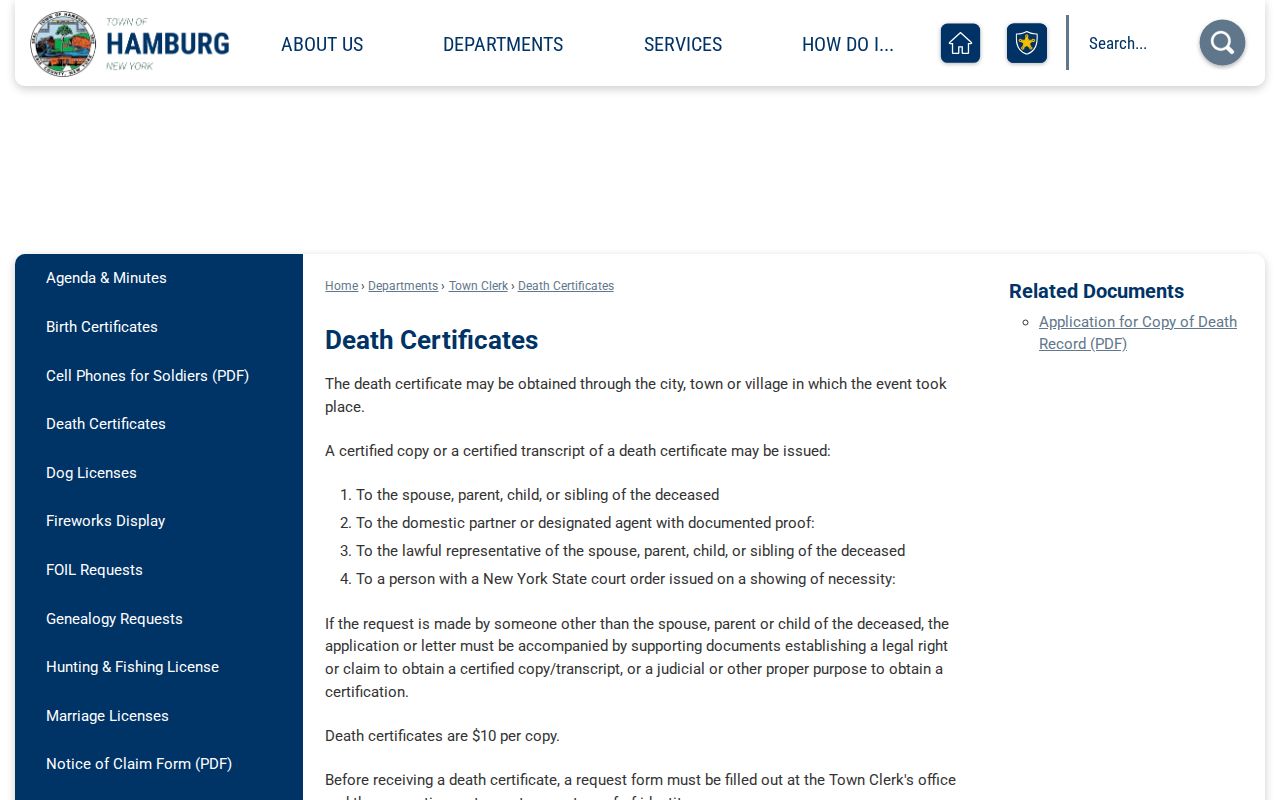
Local copies take more than a walk to the counter. The Town requires a completed application and identification. Where the rules demand it, you must also document your relationship or a legal purpose. A death copy follows published guidance. Close family, a documented legal right or claim, lawful representation, or a court order all qualify. Any of those paths answers the eligibility question.
Note: For a birth or marriage request, use the current Town or state application. A local form may not match another office's fields.
Hamburg Birth-Parent and Heir Searches
New York runs an official Adoption Information Registry. It serves registered adoptees, birth parents, and siblings. Available non-identifying information and reunion pathways are its offerings. Adoption and birth records are confidential and under court seal, and the Registry is not a public name or address search, so ordinary parcel, docket, or directory results should not be used to infer a sealed adoption. The New York State Department of Health vital-records office provides the state record route.
Heir questions take a different route. Begin with the decedent's estate in Surrogate's Court, and read the public petition, will, decree, or other available filing. Test each name against a later deed or obituary. That sequence keeps a dated estate address in context and stops you from claiming a present connection from a historical filing. It also hands the court clerk a usable case or estate reference for a copy request.
Hamburg Resident Lookup Limits
A sensible lookup can still come up empty. New York separates confidential voter records. The Address Confidentiality Program can give eligible participants a substitute address. Public assessment and deed data show an owner or a tax-mailing destination, but they do not list every occupant. Court material may sit under seal. Vital records carry their own eligibility rules. A no-result can reflect a spelling variant, a different court, an archived file, a protected record, or a change in address.
Election records have a separate limit. The NYS Poll Site Search, Voter Registration and Mail Ballot Tracker asks the registered voter for name, date of birth, county, and address information to check status and polling place. It is not an anonymous street roster. Election Law §3-103(5) limits the use of voter-registration data to election purposes. Confidential registration under §5-508 separates qualifying records from public inspection.
Lawful personal use. Use Hamburg records for legitimate personal research, family history, estate questions, civic information, or correction work. Never use a name, address, or record detail to stalk, harass, intimidate, or harm anyone.
Hamburg FOIL Record Fallbacks
When a public index ends, go to the custodian. The Town of Hamburg FOIL route accepts municipal requests online, by mail, and in person. Name the record in your request. Add the date range, the address or SBL, and every useful name variant. New York's Freedom of Information Law then sets a clock. A written request earns a grant, denial, or acknowledgment within five business days. More time means an approximate response date.
FOIL covers municipal administrative records available under the law. It does not force an agency to build a new resident list. It will not open a sealed file. It also will not hand out a vital certificate outside its statutory process. Older deeds and court material live at the Erie County Clerk counter or request channel. Genealogy holdings sit there too. A case file belongs to the court clerk. Vital material goes through the Town Clerk or state form. For directories and newspaper fragments, ask Hamburg Library or the Historical Society. Give them the specific year and repository.