
Town of Hamburg Previous Residents by Era
One Town of Hamburg address has more than one historical trail. Recorded deeds establish conveyances and legal descriptions. Directories and census schedules may show a named household at a particular point in time. Newspapers can bridge a gap, while permits and maps can date changes to the structure or street. The records do not form one continuous list, and a source should be described for what it actually proves. An owner shown in a deed, for example, is not automatically a person who lived there.
| Source | Years It Covers | Where Held | What It Shows |
|---|---|---|---|
| Erie County deed custody | 1808–present | Erie County Clerk | Recorded conveyances, parties, and legal descriptions; index and image access have separate cutoffs. |
| Hamburg town directories | 1962–1974, 1976, 1977, 1979, 1980 | Buffalo & Erie County Public Library | Dated name and address leads, subject to real gaps in the shelf run. |
| Regional suburban directories | 1963–1979; 1983–1994; 1992, 1993, 2003, 2004–present | Buffalo & Erie County Public Library | Later or overlapping regional name-and-address coverage for Hamburg. |
| State and federal census | State microfilm 1850–1925; federal public schedules 1790–1950 | Erie County Clerk, libraries, archives, and genealogy access points | Household composition, ages, relationships, and enumeration geography. |
| Hamburg and Southtowns newspapers | Title fragments from 1878–present | Library, Historical Society, Town Historian, and regional repositories | Obituaries, estate notices, social columns, property notices, and dated local context. |
Start with the present parcel when the goal is a deed chain. Start with a dated directory or census when the goal is a household at an earlier address. If the address has changed jurisdictional labels, the legal description and SBL provide a steadier bridge than a modern postal label alone.
Town of Hamburg Deed Records: Old and Online
Erie County has custody of deeds from 1808 to the present. Its online deed index begins on 1 January 1986, while online deed images begin on 1 January 1960. These are different access layers. A current index hit does not promise an image, and a historical deed in county custody does not promise a normal online party search. The Clerk's official-record system also does not search land records by street address, so the parcel result is the bridge from an address to book and page, SBL, or a party name.
The Erie County Clerk's records-kept guide documents the custody, index, and image cutoffs for the historical path.
For deeds recorded from January 1960 through December 1985, Book or Liber and Page may be necessary; the Clerk identifies the alphabetical Graves Index as the route for finding that page. Before 1960, move to the Clerk's counter, older indexes, microfilm, and deed books. That older route is not a failure of the search. It is the documented access path for a chain that predates the electronic system.
Record reality. Erie County holds very old deeds, but its historical record custody is broader than its street-search and online-image access.
Trace Previous Residents Through Erie County Deeds
Use the Erie County parcel search first. Save the exact situs address, SBL or PIN, current owner, mailing address, deed date, and book or page from Details. Then use book and page, SBL where available, or a party name in the Erie County Clerk Official Records Public Search. The most recent purchase deed can identify both the buyer and prior seller, its recording date, legal description, stated consideration when present, and references to earlier instruments.
- Find the current parcel and copy its SBL or PIN, situs address, deed date, and book or page before changing screens.
- Retrieve the latest purchase deed by book and page or party name, then record grantor, grantee, recording date, document type, and legal description.
- Search the seller from that deed as a prior grantee, comparing the legal description and SBL before accepting a match.
- Repeat the sequence backward, preserving spelling variants, initials, married names, and the record date with every link.
- At the 1986 index cutoff, shift to Book or Liber and Page, the Graves Index, counter research, microfilm, or deed books as the period requires.
Linked documents, mortgages, assignments, and satisfactions can help explain a transaction date, but they are not a substitute for the deed itself. A legal description and SBL are especially valuable when the street address has been restyled or local labels have changed. Keep a chain log that distinguishes what the recorded instrument says from what later records suggest.
Town of Hamburg Deed Record Terms Hold the Chain
Deed vocabulary matters because an old street address can be incomplete or different from the present label. The words below are plain descriptions of the fields needed to keep a past-resident trail tied to the same land. Write them down exactly as they appear in each recorded instrument, including lot, subdivision, and book references.
- Grantor and grantee
- The grantor is the party transferring an interest. The grantee is the party receiving it.
- Chain of title
- The linked sequence of recorded transfers for the same parcel or legal description, traced from one conveyance to the preceding one.
- Legal description
- The recorded land description, such as a lot, subdivision, metes-and-bounds description, or section-block-lot reference. It usually outlasts a street-label change.
- Situs address
- The physical street location used by the parcel system, distinct from the address used for tax mail.
Town of Hamburg Previous Residents in Directories and Census
Deeds follow a parcel's recorded transfers, while directories and census schedules add the household layer. The Buffalo library's town-of-Hamburg directory run covers 1962–1974, 1976, 1977, 1979, and 1980. Its Southeast Suburban, South Towns, and South Suburban volumes can cover other periods but must be checked volume by volume. For the shelf years, reverse or address-order sections can be useful when they are present. The historical collections themselves are described in the Town of Hamburg city directories.
- Choose the directory year closest to the transfer date and search the street or address-order section if that volume includes one.
- Move from the address lead to the alphabetic entry, recording the exact name spelling and confirmed notation.
- Check the next available directory or regional successor title instead of assuming that a missing year means the household left.
- Pair early Hamburg state census material from 1855, 1865, and 1875 with nearby federal schedules; use the County Clerk's in-person microfilm route for broader county coverage.
- For later decades, pair the dated directory with the appropriate federal census, remembering that 1950 is the newest public federal schedule at the research date.
The New York State Archives historical vital-record research page is a useful route once a household trail points to a birth, marriage, or death record.
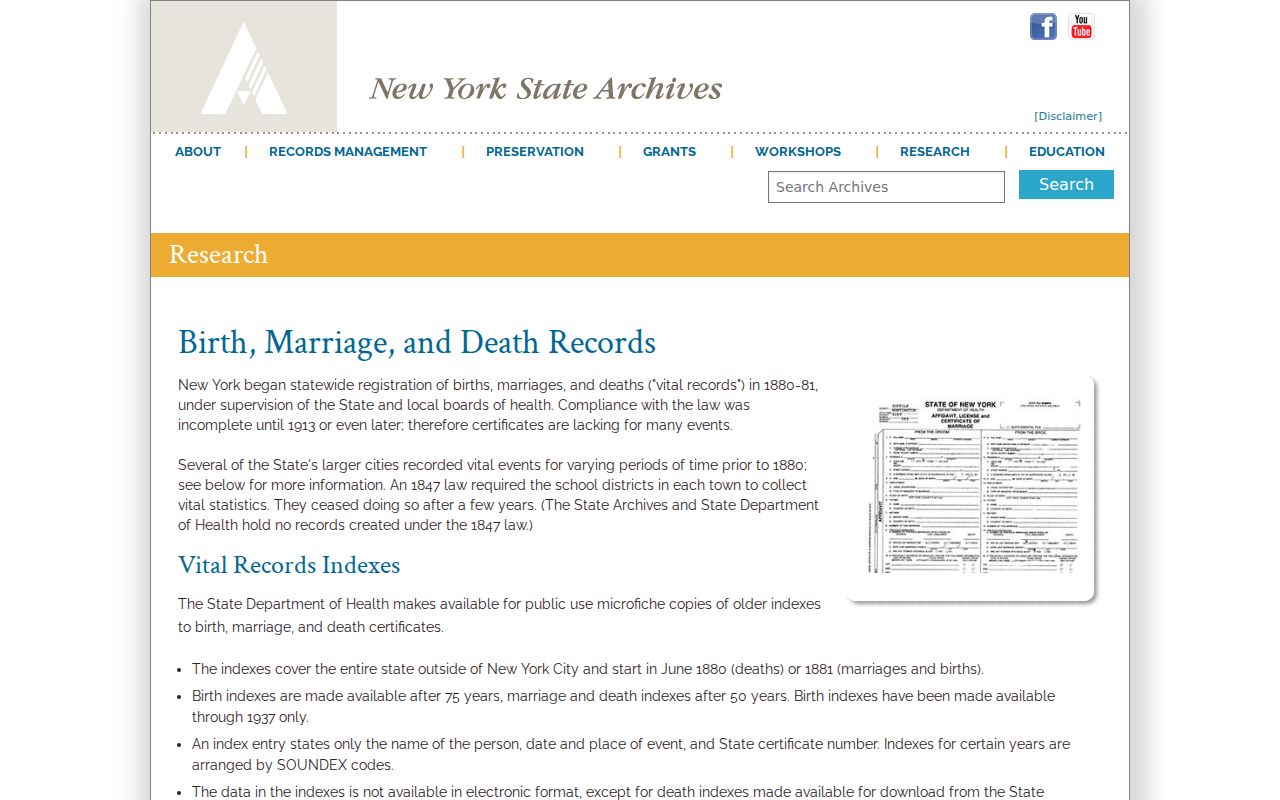
A dated vital index or record can help test a family connection suggested by a directory, census, obituary, or estate file. It does not replace the deed chain, and access rules vary by record type and date. Use the archive and local registrar routes that apply to the specific event.
Town of Hamburg Newspaper and Probate Endpoints
Once a deed or directory produces a former name, Hamburg and Southtowns newspapers may fill the human part of the address trail. The Hamburg Sentinel, Hamburg Sun, Hamburg Sun and Erie County Independent, and The Sun and Erie County Independent have fragmented runs among local and regional repositories. Search an exact name, married or maiden form, the town or village label, and an approximate date. Preserve the issue date, page, and repository rather than relying on a general reference to a Hamburg newspaper.
An obituary can identify a death and surviving family. Estate notices and Surrogate's Court files can point to a fiduciary, heirs, notices, or an earlier mailing address. These are historical clues and can be stale. If a transfer involved an estate, search the estate or fiduciary name and the later deed rather than assuming the deceased person remained in control of the parcel.
Town of Hamburg Boundary Labels Alter Addresses
A backward address trail can cross place names without crossing the same parcel. Town of Hamburg was created in 1812 and reduced to its present size by 1850 as West Seneca and Orchard Park formed from the original town. The Village of Hamburg incorporated in 1874, Blasdell in 1898, and a 1948 annexation added part of Hamburg to the village. Older materials may say Hamburg, East Hamburg, West Seneca, Orchard Park, Blasdell, Lake View, or a village label. Use the SBL, legal description, tax maps, road-name variants, and census district to bridge the label change.
Why 102 Town of Hamburg Parcels Need a Date Check
In June 2026, Erie County announced the planned conveyance of 102 county-owned Hamburg parcels acquired through in rem proceedings to the Town for public recreation. The release says they total 9.8 acres and are mainly grouped where streets were never developed. A present owner or map label can therefore change as the conveyance closes, and a planned but unbuilt street can create an apparent gap in an address trail. Date the parcel result and compare it with the recorded instrument before drawing a conclusion from a current map.
Town of Hamburg Previous-Resident Research Has Limits
Past-resident research fits family history, estate work, preservation, and personal curiosity about an address. It should be limited to documented records and respectful contact choices. Parcel files, deeds, and directories do not reveal every person who may have been present, and a mailing address can belong to an estate, organization, or another location. A missing result also cannot prove that a person was absent from Town of Hamburg.
Lawful use. Use historical records to understand an address or family trail, never to stalk, harass, or track a living person.